Talking the language of Human Rights activism in Romania
 Amnesty International Bucharest Group, the first and only local group of Amnesty International in Romania, was founded in August 2014 gathering at the very beginning 10 members only.Since then, the group developed and it consists now of 30 members who undertook four campaigns in order to raise awareness about refugee and asylum-seekers’ rights, sexual and reproductive rights, women’s rights, freedom of expression, political and civic rights and the ban of torture practices.
Ionela Maria Ciolan is the initiator of the Volunteer Facilitators movement of Amnesty International in Romania and the founder and leader of the first Human Rights activists group of Amnesty in her country (Amnesty International Bucharest Group). She has extensive experience in youth work, advocacy and Human Rights (HR) and had organized 9 international campaigns in Romania concerning Rroma/ LGBT /sexual and reproductive rights, women’s rights, refugee and asylum-seekers’ rights, housing rights, freedom of speech, etc.
Alexandra: Since 1961, Amnesty International has been involved in major campaigns, investigations and communications in order to promote a world of Human Rights for all. It has more than 7 million activists, members, supporter and donors all around the world. In Romania, you have been working as an Amnesty Volunteer Facilitator since 2011 and afterwards you created Amnesty International Bucharest Group. What were the incentives that led to the establishment of the AI local group in Romania?
Ionela: After 3 years of intensive collaboration and 6 Human Rights ca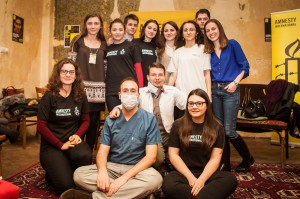 mpaigns with Amnesty as a Volunteer Facilitator, I have decided that I got enough experience and understanding of the way the organization works in order to move to the next level. Founding this group came from my desire to promote AI and its values in my country. I wish I couldbring my contribution towards changing the Romanian mentality concerning Human Rights, namely making ordinary citizens more tolerant and open to embrace diversity. A large number of them do not know what Human Rights are and have never had any Human Rights education in school or throughout their life. Thus, the degree of intolerance and discrimination in Romania is, at some extent, worrisome.
Apart from my idealistic goal to improve Romanians’ attitude in this direction, I have also been motivated by my willing to positively change Romania’s image abroad. If my country is internationally perceived as one where various Human Rights (i.e. Roma/ women/ LGBT/ prisoners’ rights, etc.) are persistently violated, I wanted to stand up against such practices and bring my contribution towards building another side of Romania, one, where we care about Human Right, respect them and fight to promote them, both locally and globally.
Alexandra: You have served as a Volunteer Facilitator at AI for almost four years now. What are your responsibilities as a volunteer facilitator/group leader in Romania?
Ionela: As a Volunteer Facilitator, I’ve been in charge with the organization of several Amnesty campaigns over here (i.e. finding out what are the most efficient ways to organize a campaign on a certain subject, preparing working strategy plans, recruiting volunteers, coordinating and training them, promoting the events through social media, maintaining a constant contact with my Regional Coordinator from the International Secretariat in London, preparing the logistics, facilitating the events, delivering Amnesty messages on all their specific campaigns, collecting petitions and letters of support and sending them to London, etc.).
As a group leader, I would mention that I am in charge with the internal communication of Amnesty International Bucharest Group, the coordination of my team of activists, namely motivating and offering them support, intermediating the communication between the group and our coordinator from the International Secretariat, etc. I also make sure that the message we present through our campaigns and other coordination tasks perfectly matches with the one promoted by Amnesty.
Alexandra: Since 2011, you and Amnesty International Bucharest Group have organized several campaigns that aimed to raise awareness for several causes such as Roma rights (“Stop forced evictions of Roma community in Romania”), the fight against torture (“Stop torture”), Women’s rights (“My body, my rights”), etc. Could you recall any moment or any lesson about freedom and dignity that had a tremendous impact on your activity as a volunteer for AI in Romania and motivated you to work harder in order to improve the Human Rights situation in Romania?
Ionela: Last year, I was involved in the 3rd Human Rights Action Camp of Amnesty in Bulgaria where we’ve discussed the rights of refugees and asylum-seekers. At that time, the refugee crisis wasn’t so widely covered by International media; however, this does not mean at that time asylum seekers’ rights were not violated. Apart from AI activists from all over Europe, some refugees accepted to attend the camp with us. The stories they shared were simply heartbreaking. Very briefly, I will give you some examples and I wish readers could put themselves in the shoes of these people.
In 2011, when conflict erupted in Libya, Said, a 10-year old child was playing in a football competition in Libya. Against his will, Libyan authorities put him in an overcrowded boat and sent him to Italy. Apparently, this happened at Gaddafi’s instructions when Italian forces joined the NATO air campaign against Libya. However, there can be no justification for sending away a helpless minor in a foreign country where, as you can imagine, he didn’t know anyone and had zero-knowledge of Italian. Not even today, after 4 years, he couldn’t reconnect with his family. He doesn’t know if they are still alive or not, if they flew away from Libya or not.
Other refugees shared with us critical moments from their life back in their home countries where war is a daily fact. Escaping from war-torn Syria or Iraq was not an easy task at all, but a risky trip by boat towards unknown lands. All these personal recollections of the refugees’ journey to Europe have touched me so deeply that I returned to Romania with the purpose of creating the AI group we have today. I wanted to fight harder in order to spread the AI Human Rights cases in Romania. If until this camp, I wasn’t very convinced that I was ready to move from a single volunteer activity to leading a group of volunteers, that experience and the courage of the refugees I’ve met, gave me the reasons and the strength to be more determined in promoting human rights and less worried about what if I’ll fail.
Alexandra: 2015 is definitely a watershed moment for all development workers involved in the fight for a better world for all. Human Rights are at the core of all Sustainable Development Goals (SDGs) that are about to be adopted in 2015. From your point of view, as an Human Rights activist and a youth worker, how would you evaluate the new post-2015 agenda? If we define it as a new Human Rights agenda, how would you assess both its potential achievements and shortcomings?
Ionela: As we all know, the post-2015 Agenda comprises 17 Sustainable Development Goals and 169 targets that are to be attained by 2030. Of course, it is an ambitious, wide-range global plan to create a better world for all. From a Human Rights activist point of view, the new SDGs tackle some of the most pressing issues of our time: ending extreme poverty and hunger, reduce gender inequality, increase access to health care and education, achieve universal and equitable access to safe and affordable drinking water, etc.; some of these things seem pretty basic and are taken for granted by many of us. One of the most relevant aspect of the new UN agenda is the fact that the SDGs do not focus anymore on developing countries only (like the MDGs used to do), but they strongly claim that even in the most advanced nations, there are people left aside, living at the edge of poverty, people who don’t have access to minimum basic facilities. Therefore, the UN system aims to raise a challenging debate with the participation of each and every country to analyse their own level of achievement in regards to the proposed sustainable development goals.
While the new SDGs framework can make a lasting impact in the world as we know it and improve the current situation, there are many doubts about the results of the post-2015 Agenda. The main critique comes from the fact that some of the targets are vaguely expressed, generally presented and hard to measure and put into practice. Additionally, we have to keep in mind that some goals, although they sound really appealing, cannot (easily) be achieved within the desired timeframe. We also have to ask ourselves if all the countries have the necessary resources (material, technological and the knowledge) to accomplish these objectives. And in this particular case, how would countries select their priority items? Is it there any scale system to measure what goals are the most important or in other words, the first / second priorities in a country?
Alexandra: Keeping in mind the new post-2015 Agenda, what are the goals Romania should place more emphasis on in the next coming years?
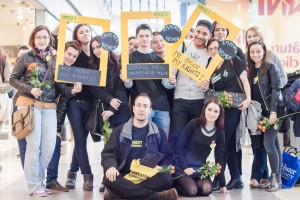 Ionela: If we are looking at all the 17 SDGs is hard to select the areas where we have to be more engaged. However, keeping in mind the real concerns of Romanians, I believe that ending poverty (or at least, diminishing it), increasing health care, investing in quality education and promoting sustainable, inclusive economic growth are the areas were we should invest more. Let me also add that achieving greater equality and empower women and girls should be one of our priorities and we need to keep on fighting the battle in order to reduce domestic violence, end human trafficking (affecting young girls and women in general), and ensure access to sexual and reproductive health and reproductive rights. In this direction, I totally support the idea of having sexual and reproductive education programs in schools. At the moment, the rates of teen birth and abortion (under 19- year old girls) in Romania are one of the highest in Europe; moreover, 60% of sexual active teenagers (teenagers between 15-19- year old) have never used contraception. This can be a real problem not only in terms of birth or abortion numbers, but also concerning the spread of STDs. Needless to add, the economic impact on the state.
Alexandra: These days, many people are interested in humanitarian and development work. What is the message you would like to pass on to those who are interested by the activities of the AI group in Romania?
Ionela: I invite all those interested in the work of Amnesty International to visit AI’s website and read about the ongoing campaigns and sign the petitions. By signing a petition, promoting it and encouraging friends to do the same, we are spreading the message of Amnesty and we are gathering support for that case. It’s not a singular example where millions of individuals from different corners of the world supported and promoted the same case, thus helping Amnesty to have a stronger impact and succeed in freeing people, stopping governments from violating human rights and finally changing some people’s lives. Because each of us can have the power to bring his/ her contribute to changing the world in a better place.
They can also join Amnesty by becoming online members. Needless to add, if they consider that they need to acquire more knowledge regarding human rights, they can join Amnesty’s first massive open online course (MOOC) on freedom of expression, which is now open for registration.
*
 Ionela is the first Romanian in the history of Amnesty International who was selected as an International Movement Delegate for Europe to participate in the 2015 Amnesty’s International Council Meeting. This is the highest position that an activist can have in the organization and Ionela has represented all volunteers and local groups from the European countries where Amnesty doesn’t have an office.
Recently, she extended her experience with a Professional Fellowship granted by the U.S. Department of State and an internship at Chicago Coalition for the Homeless.
A PhD Candidate in International Relations, her research is focused on the European Neighbourhood Policy, the EU’s Eastern Partnership and the Union’s relations with Russia.
 ork is to understand the paradigm shift brought by the phenomenon of globalization as a starting point for finding pragmatic solutions for this important change that is continuously taking place based on philosophical moral arguments. The idea of Global Justice is to help address avoidable current global issues in such a manner that the following evolutions in alleviating world poverty and human rights violations to be aligned with today world’s needs. The SDGs that are about to be implemented starting with 2015, for example, are aimed to respond to the failures of the previous actions in this respect, are an example of some Global Justice efforts.